




Home > Legal insights > DECREE NO. 255/2026/ND-CP: IDENTIFICATION OF RELATED PARTY RELATIONSHIPS AND SEVERAL NOTABLE NEW PROVISION
DECREE NO. 255/2026/ND-CP: IDENTIFICATION OF RELATED PARTY RELATIONSHIPS AND SEVERAL NOTABLE NEW PROVISION
Transactions among enterprises sharing ownership, management, or control are common practices within corporate groups and related-party business models. Given the lack of absolute independence among the parties, tax legislation sets forth specific principles for identifying and managing related-party transactions. This aims to ensure that tax liabilities are determined in accordance with the transaction substance and the arm’s length principle. On June 30, 2026, the Government promulgated Decree No. 255/2026/ND-CP, which takes effect on July 1, 2026, and is applicable from the 2026 corporate income tax (CIT) period, replacing Decree No. 132/2020/ND-CP and Decree No. 20/2025/ND-CP. This article focuses on clarifying the concept of related-party transactions, the circumstances under which related-party relationships are established, and several notable changes in the criteria for identifying such relationships, thereby facilitating enterprises and taxpayers in their self-review and compliance efforts.
1. Definition of related-party transactions and relationships
According to Clause 1, Article 4 of Decree No. 255/2026/ND-CP, related-party transactions include transactions of purchasing, selling, exchanging, leasing, renting, borrowing, lending, transferring, and assigning goods, and providing services; borrowing, lending, financial services, financial guarantees, and other financial instruments; purchasing, selling, exchanging, leasing, renting, borrowing, lending, transferring, and assigning tangible and intangible assets; and agreements on the joint purchase, sale, and use of resources such as assets, capital, labor, and cost-sharing among related parties, excluding business transactions involving goods and services subject to the State’s pricing scope in accordance with the law on pricing.
To identify related parties, Clause 17, Article 4 of the Law on Tax Administration 2025 specifies the fundamental categories of relationships, including: one party directly or indirectly participating in the management, control, or capital contribution of the other party; parties being jointly subject to the direct or indirect management or control of an organization or individual; parties having the same organization or individual participating in their capital contribution; or enterprises being managed or controlled by individuals who are members of the same family.
Decree No. 255/2026/ND-CP specifies the cases for identifying related-party relationships in Article 5, while consistently cross-referencing the concept of ‘related parties’ in Clause 17, Article 4 of the Law on Tax Administration 2025.
2. 12 cases for identifying related parties
Clause 2, Article 5 of Decree No. 255/2026/ND-CP specifies 12 cases for identifying related parties, which can be categorized as follows:
(1) Capital-based relationships (04 cases)
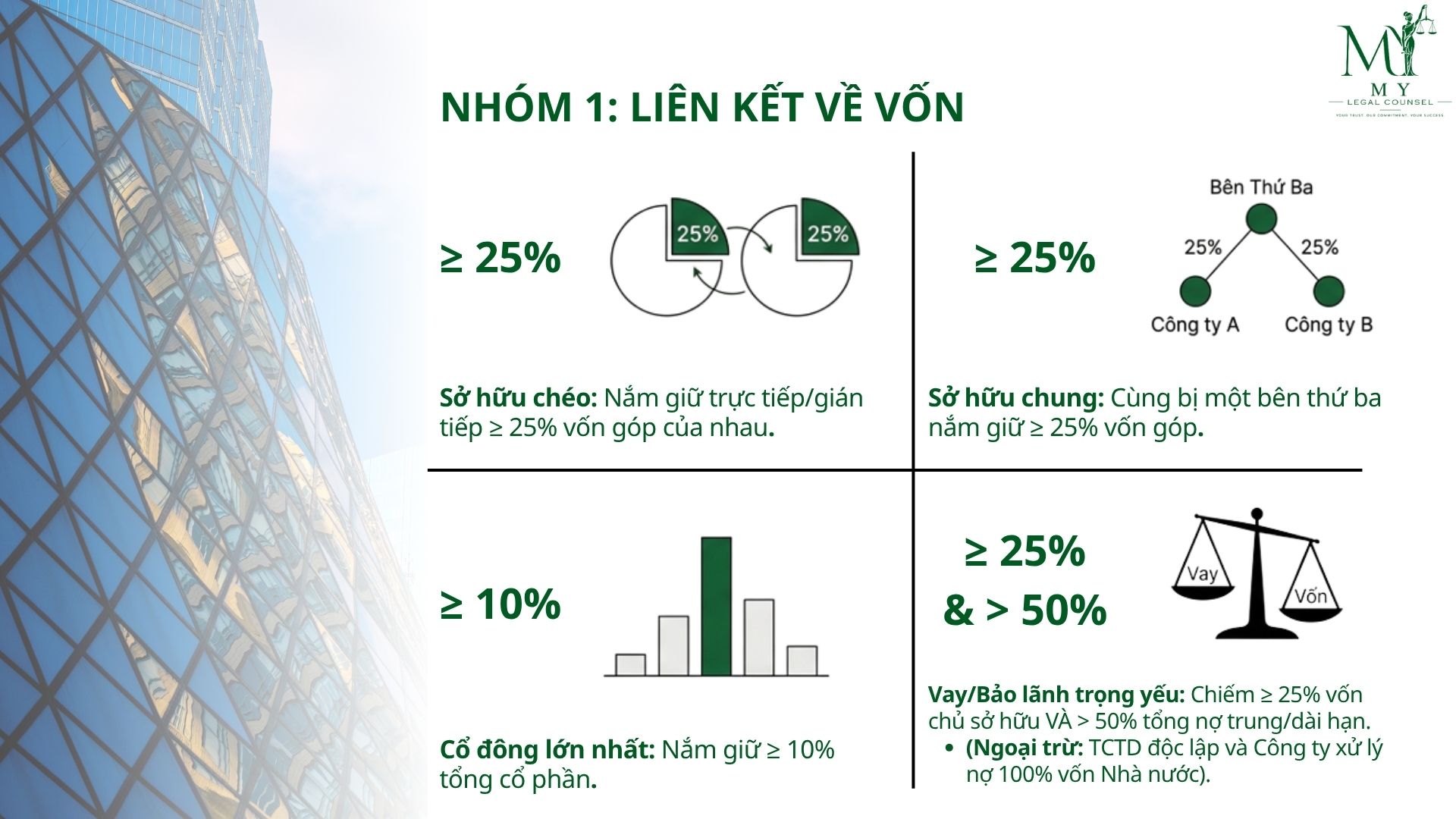
– One enterprise directly or indirectly holds at least 25% of the owner’s equity of the other enterprise.
Example: Company A acquires 30% of the shares of Company X. Thus, A and X are deemed to have a related-party relationship because A directly holds more than 25% of the owner’s equity in Company X
– Both enterprises have at least 25% of their owner’s equity directly or indirectly held by a third party.
Example: Mr. A is the owner of Company A; Company A acquires 30% of the capital of Company X and 50% of the capital of Company Y. Although Mr. A does not directly hold shares in Company X and Company Y in his own name, through Company A, he indirectly holds over 25% of the owner’s equity in both entities. Therefore, Company X and Company Y are still deemed to have a related-party relationship.
– One enterprise is the largest shareholder of owner’s equity and directly or indirectly holds at least 10% of the total shares of the other enterprise;
Example: Company A acquires 12% of the shares of Company B and is the largest shareholder of Company B. Company A and Company B are deemed to be related parties.
– One enterprise guarantees or lends capital to another enterprise in any form (including loans from third parties guaranteed by the financial resources of a related party and financial transactions of a similar nature), provided that the total outstanding loan balance of the borrowing enterprise owed to the lending or guaranteeing enterprise is at least equal to 25% of the owner’s equity of the borrowing enterprise and accounts for over 50% of the total outstanding balance of all medium and long-term debts of the borrowing enterprise.
Example: Company A has an owner’s equity of VND 100 billion and total medium and long-term debts of VND 80 billion. Company B grants Company A a medium-term loan of VND 45 billion. In this case, two conditions must be considered:
- Condition 1: The ratio of the loan to the owner’s equity = 45 billion / 100 billion = 45% (Satisfying the condition of 25%).
- Condition 2: The ratio of the loan to the total medium and long-term debts of A = 45 billion / 80 billion = 56.25% (Satisfying the condition of > 50%).
Thus, A and B have a related-party relationship
However, the criterion specified in Point d, Clause 2, Article 5 does not apply in the following cases:
- The guarantor or lender is an economic organization operating in accordance with the Law on Credit Institutions No. 32/2024/QH15 (amended and supplemented by Law No. 96/2025/QH15) that does not directly or indirectly participate in the management, control, capital contribution, or investment in the borrowing enterprise or guaranteed enterprise as prescribed in Points a, c, đ, e, g, h, k, l, and m of this Clause.
- The guarantor or lender is an economic organization operating in accordance with the Law on Credit Institutions No. 32/2024/QH15 (amended and supplemented by Law No. 96/2025/QH15), and the borrowing or guaranteed enterprise is not jointly subject to the direct or indirect management, control, capital contribution, or investment of another party as prescribed in Points b, e, and i of this Clause.
Example: Where the guarantor or lender is a Bank or Credit Institution:
Case not deemed a related-party relationship: Company X has an owner’s equity of VND 50 billion. Subsequently, Company X borrows VND 150 billion from Bank Y. Although this loan is three times the owner’s equity, the relationship between X and Y is merely an ordinary credit granting relationship; Y does not participate in the management of, nor hold shares in X, and neither X nor Y is subject to the management of any third party. Therefore, X and Y are not related parties.
Case still deemed a related-party relationship: Credit Institution Y grants a loan to Company X, and simultaneously, Y and X maintain an ownership or control relationship that satisfies another criterion specified in Clause 2, Article 5. In this event, the exception for ordinary credit granting relationships does not preclude a related-party relationship arising from such ownership or control criterion.
- The creditor or guarantor is an organization in which the State owns 100% of charter capital, functioning in debt trading and processing, and does not directly or indirectly participate in the management, control, capital contribution, or investment in the debtor enterprise or the guaranteed enterprise as prescribed in Points a and c of this Clause.”
Example 2: Where the Creditor or Guarantor is a State-owned Debt Processing Organization:
Company X has a medium-term debt of VND 200 billion, which is acquired by the Vietnam Debt and Asset Trading Corporation (DATC). If DATC solely performs its debt trading and processing functions and does not directly or indirectly participate in the management, control, capital contribution, or investment in Company X according to the criteria cross-referenced in Point d, Clause 2, Article 5, then this creditor-debtor relationship does not give rise to a related-party relationship based solely on the aforementioned lending/guarantee criterion
(2) Relationships through management and control (06 cases)
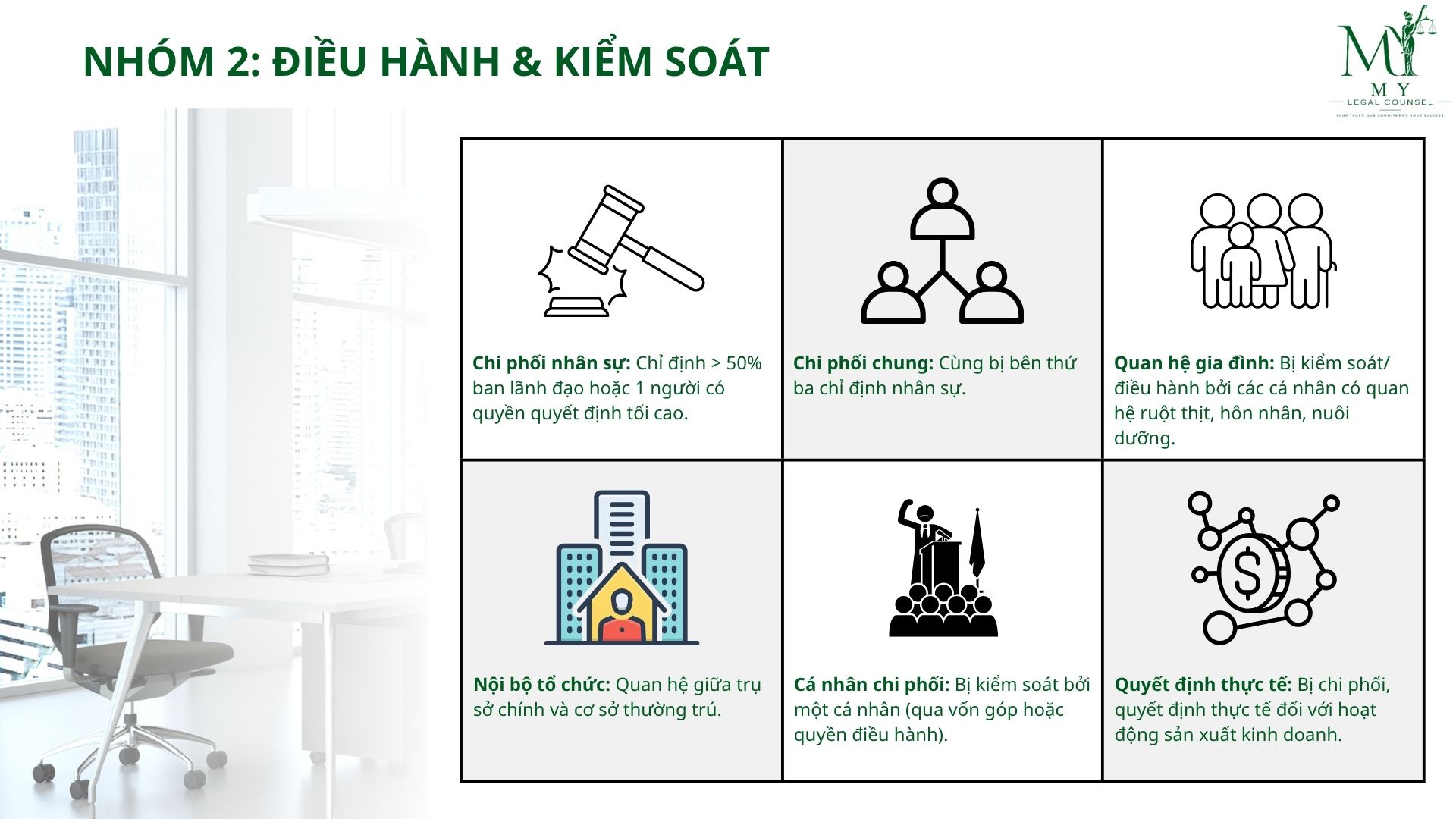
– One enterprise appoints members of the executive board of management or control of another enterprise, provided that the number of members appointed by the first enterprise accounts for over 50% of the total members of the executive board of management or control of the second enterprise; or one member appointed by the first enterprise has the right to decide the financial policies or business operations of the second enterprise;
Example: Company A and Company B agree that Company A has the right to appoint 3 out of 5 members of the Board of Directors of Company B. The number of members appointed by A accounts for 60% of the total members of the Board of Directors of B; therefore, A and B have a related-party relationship.
– Both enterprises have over 50% of their management board members, or share a management board member with the right to decide financial policies or business operations, appointed by a third party;
Example: Company X and Company Y are independent and do not contribute capital to each other, but both have Mr. A as their Chief Financial Officer (CFO). Mr. A is appointed by the same third party and has the authority to decide the financial policies of both X and Y. In this case, X and Y are deemed to be related parties.
– Two enterprises are managed or controlled in terms of personnel, finance, and business operations by individuals who belong to one of the following relationships:
- Spouses;
- Biological parents, adoptive parents, stepfathers, stepmothers, parents-in-law;
- Biological children, adopted children, stepchildren of spouses, daughters-in-law, sons-in-law;
- Siblings with the same parents, half-siblings, brothers-in-law, and sisters-in-law of siblings with the same parents or half-siblings;
- Paternal grandparents, maternal grandparents; paternal grandchildren, maternal grandchildren;
- Biological aunts, uncles, and nieces/nephews;
Example: Mr. H has the right to manage and control Company A; Mrs. M has the right to manage and control Company B; Mr. H and Mrs. M are spouses. In this case, Company A and Company B are deemed to have a related-party relationship based on the family relationship criterion.
– Two business establishments have a relationship of head office and permanent establishment, or both are permanent establishments of a foreign organization or individual;
Example: The head office of Company A in South Korea sells raw materials to its Branch in Bac Ninh; the transaction between the head office and this Branch is deemed a related-party transaction.
– Enterprises are subject to the control of an individual through this individual’s capital contribution to those enterprises or direct participation in the management of the enterprises;
Example: Mr. A owns 60% of the charter capital in Company X and 70% of the charter capital in Company Y. Company X and Company Y are independent and do not contribute capital to each other but are jointly subject to the absolute control of Mr. A through his overwhelming capital contribution ratios. Therefore, X and Y are related parties.
– Other cases where an enterprise (including independently accounting branches that declare and pay corporate income tax) is subject to the actual management, control, or decision-making regarding its production and business operations by the other enterprise.”
Example: Company A is a brand owner in South Korea, and Company B is a garment factory in Vietnam. The two parties have no capital contribution or family relationship, but by agreement, A exclusively supplies machinery and raw materials, and determines the output and processing prices of B. If these rights allow A to actually manage, control, or make decisions regarding the production and business operations of B, A and B may be identified as related parties.
(3) Other relationships (02 cases)
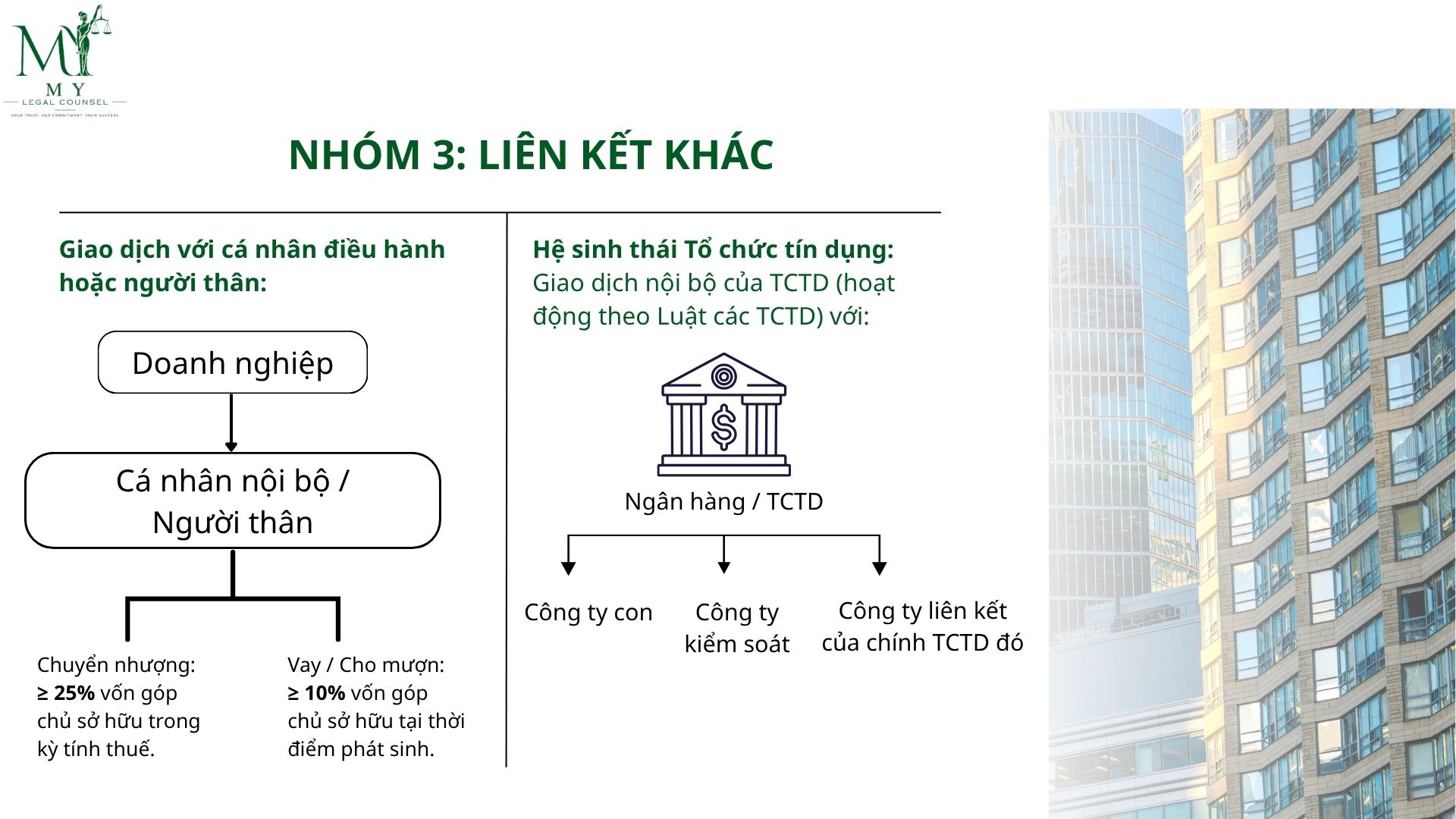
– The enterprise incurs transactions of transferring or receiving the transfer of capital contributions accounting for at least 25% of the owner’s equity of the enterprise during the tax period; borrowing, lending, temporarily borrowing, or temporarily lending at least 10% of the owner’s equity at the time the transaction incurs during the tax period with an individual managing or controlling the enterprise, or with an individual belonging to one of the relationships prescribed in Point g of this Clause;
Example:
Regarding transactions of transferring or receiving the transfer of capital contributions of 25% or more during the tax period: Company X has an owner’s equity of VND 10 billion. Mr. A is currently the General Director of Company X. Company X repurchases shares held by Mr. A worth VND 3 billion (equivalent to 30% of the owner’s equity). In this case, Company X and Mr. A are deemed to have a related-party relationship.
Regarding transactions of borrowing, lending, temporarily borrowing, or temporarily lending of 10% or more: Company Y has an owner’s equity of VND 50 billion. Mr. B is the Chairman of the Members’ Council of Company Y; Mrs. C is the wife of Mr. B and lends Company Y VND 6 billion, equivalent to 12% of the owner’s equity. Accordingly, Company Y and Mrs. C are deemed to have a related-party relationship based on this criterion.
– Credit institutions with their subsidiaries, controlling companies, or affiliated companies in accordance with the Law on Credit Institutions No. 32/2024/QH15 (amended and supplemented by Law No. 96/2025/QH15).
Example: Joint Stock Commercial Bank X contributes capital to establish Debt and Asset Management Company Limited M. The relationship between Bank X and Company M is determined as a related-party relationship.
3. Several notable new highlights regarding criteria for identifying related-party relationships
Firstly, Decree No. 255/2026/ND-CP supplements a case where the criterion for identifying related-party relationships specified in Point d, Clause 2, Article 5 does not apply: when the creditor or guarantor is an organization in which the State owns 100% of charter capital, functioning in debt trading and processing. This exemption only applies when such organization does not directly or indirectly participate in the management, control, capital contribution, or investment in the debtor enterprise or guaranteed enterprise according to the criteria cross-referenced by the Decree. Therefore, this is not a general exclusion of State-owned debt processing organizations from the scope of related-party relationships, but rather a specific exemption regarding the criterion arising from the creditor/guarantor relationship.
Secondly, Decree No. 255/2026/ND-CP adds ‘temporarily borrowing, temporarily lending’ to the criterion in Point l, Clause 2, Article 5. Compared to Decree No. 132/2020/ND-CP, this addition helps cover transactions where related enterprises or individuals transfer or use resources in the form of temporarily borrowing or lending, even if no interest or usage fees arise. Enterprises should therefore note that labeling a transaction as ‘temporarily borrowing’ instead of ‘borrowing’ does not automatically exclude it from being considered a related-party relationship; it is still necessary to review the subjects, transaction value, and statutory thresholds.
4. Practical notes for enterprises
Decree No. 255/2026/ND-CP takes effect on July 1, 2026, and is applicable from the 2026 corporate income tax period. When identifying related-party relationships, enterprises should not only review capital ownership ratios but must concurrently examine management and control rights, family relationships, loan/guarantee relationships, and borrowing/lending transactions. Correctly identifying related parties is the initial step for enterprises to further assess their obligations to declare and prepare Transfer Pricing Local Files under Decree No. 255/2026/ND-CP.
Disclaimer: This article is prepared for the purpose of providing information and disseminating legal knowledge, and does not constitute legal advice for any specific case. The content may be updated subject to changes in the law and practical application. Clients are advised to consult professional opinions before making decisions based on the contents mentioned herein
Related posts